
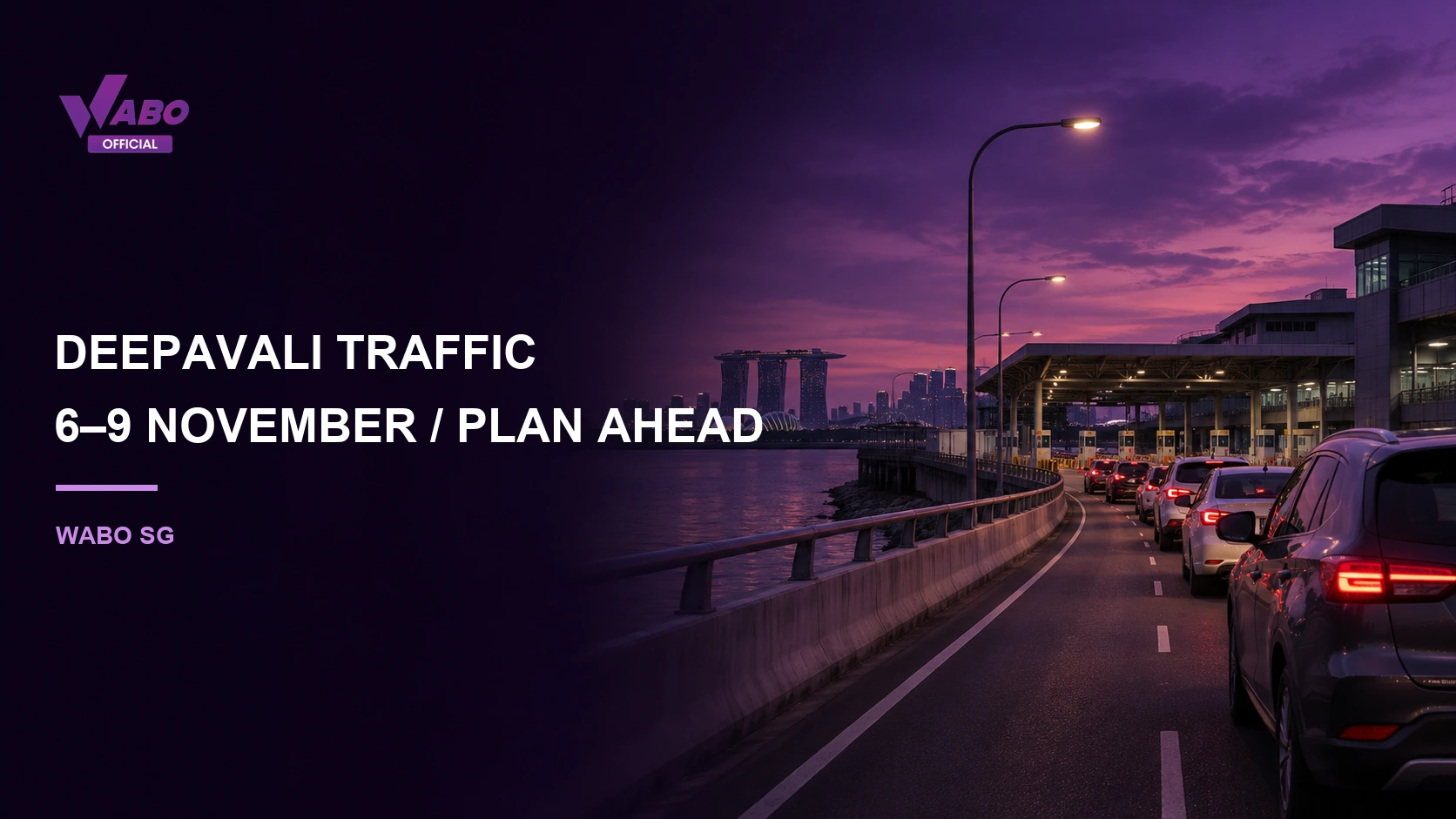
The upcoming Deepavali long weekend is a good reason to check your Singapore–Johor journey before setting out. In its 1 November advisory, the Immigration & Checkpoints Authority expects heavy traffic at Woodlands and Tuas from Friday, 6 November to Monday, 9 November 2026. That is the confirmed forward-looking notice behind this WABO SG travel guide.
Woodlands traffic also appeared in Singapore’s Google Trends results on 5 November. A trending incident phrase is not a live clearance estimate. For a journey today or over the weekend, use the current ICA announcement and LTA traffic views rather than treating a forwarded image as the latest position.
A busy-weekend warning is not a queue-time promise
ICA’s advisory identifies the period when heavier demand is expected. It does not tell every traveller how long a particular crossing will take. Direction, checkpoint, vehicle type and time of arrival all matter when interpreting a traffic update.
Build your plan around the journey you are actually making. A report about cars departing Singapore is not automatically a report about buses arriving in Singapore. Write down the direction and mode before comparing advice. This small distinction makes it easier to recognise when a message is relevant to your trip and when it describes a different queue.
Check the image time before reading the traffic
LTA’s OneMotoring traffic-camera page is a useful official starting point for road conditions. Read the camera location and displayed timestamp before interpreting the number of vehicles in view. A saved picture can circulate long after the scene has changed.
A camera gives a view of a section of road, not a complete prediction of your door-to-door journey. Compare it with the current advisory and the rest of your route. Avoid calculating an exact wait from a single still image. It is more useful to decide whether you need extra flexibility than to attach false precision to an uncertain crossing.
Compare a route as a whole
Choosing between Woodlands and Tuas means considering where you start and where you need to arrive, not just which checkpoint looks quieter in one picture. A longer approach or return drive can change the usefulness of a route choice.
If you are using public transport, check the operator’s current service information and the boarding point separately. Do not assume that a road camera shows conditions inside passenger halls. Keep your outbound and return plans together, with time for transfers and a fallback if the day takes longer than expected. A route that works for a short visit may not suit a tightly timed appointment.
Prepare documents and practical essentials beforehand
Use the official immigration and transport pages for your own traveller and vehicle requirements. Check the dates and applicability at home, where you have time to resolve a question. A traffic article cannot determine whether every member of a group has the right documentation.
Keep essential information accessible without relying on a single screenshot or a fading phone battery. If family members are travelling together, agree on the destination and contact plan before entering a queue. For children or older relatives, consider water, comfort and realistic breaks when deciding whether the planned day remains practical.
Make room to change the day’s plan
A crossing is easier to manage when every activity does not depend on one exact arrival minute. Decide in advance which booking or stop could move if travel takes longer. Tell the people expecting you that border conditions may affect the schedule.
The same principle applies to the return trip. Recheck conditions before leaving your last stop, rather than assuming the morning’s view still applies. If you are driving, use a safe stopping place to review information. Passengers can help with updates, but the driver should remain focused on the road and instructions at the checkpoint.
Keep the sources distinct when sharing an update
When sending a useful traffic message, include the source link, observation time, direction and mode. A short note with those details is more helpful than a dramatic image with no context. If you cannot confirm an incident or its current status, share the official update route instead of repeating the claim.
WABO SG readers can use the WABO SG destination for the Singapore brand route and return to this site’s local travel guides for planning context. Our AMK Hub and Rail Corridor articles cover different journeys; they should not be mistaken for border-clearance advice. For the crossing itself, the current ICA and LTA information remains the starting point.
Sources and further context
- ICA: Deepavali long-weekend checkpoint advisory
- LTA OneMotoring: official traffic cameras
- LTA OneMotoring: traffic information
Frequently asked questions
Which dates does ICA’s Deepavali advisory cover?
It expects heavy traffic at Woodlands and Tuas from 6 to 9 November 2026.
Can a camera image tell me my exact waiting time?
No. Check its location and timestamp, then consider the rest of the journey and current official updates.
Should I assume both travel directions are equally busy?
No. Match every update to the checkpoint, direction and transport mode you are using.
Where should I check before leaving?
Use ICA’s current advisory and LTA OneMotoring’s traffic information and camera pages. Recheck before your return journey too.